For millions of families, the workday doesn’t begin at 9 a.m. and end at 5 p.m. Parents work early mornings, evenings, overnight shifts, weekends, and schedules that can change from one week — or one day — to the next.
But child care hasn’t kept pace.
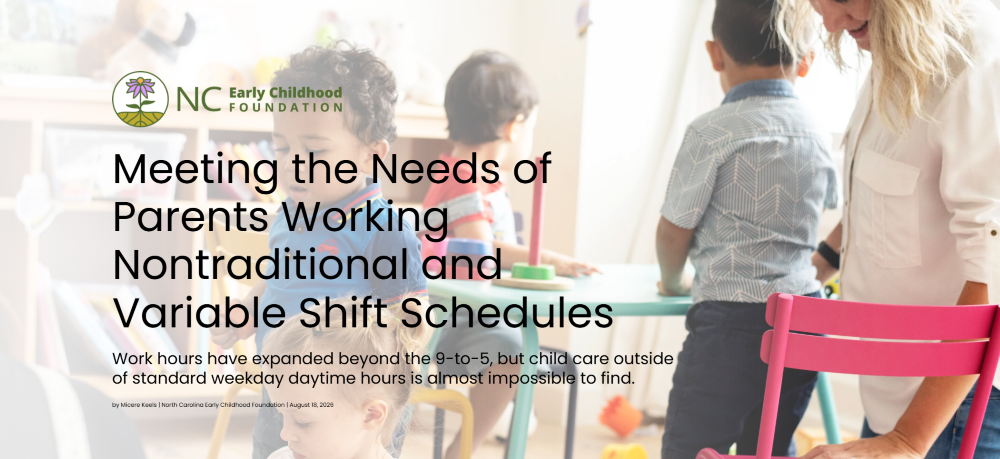
A new report from the North Carolina Early Childhood Foundation, “Meeting the Needs of Parents Working Nontraditional and Variable Shift Schedules,” explores the difficult choices families face when work schedules and available child care simply don’t line up.
The report also looks beyond the challenges to potential solutions, examining how employers, policymakers, and child care providers can help create greater stability and flexibility for families working outside traditional hours.
Few child care centers operate outside traditional weekday hours, leaving many parents to piece together care from relatives, friends, neighbors, and multiple caregivers. For parents with unpredictable schedules, even arranging that care can be nearly impossible.
Workplace practices can make a difference. Family Forward NC® research shows that 81% of working adults consider flexible hours and schedules a top workplace priority. In comparison, 40% of North Carolina parents say they have left a job because it lacked flexibility.
More predictable scheduling can help parents plan for child care and other family responsibilities. But workplace flexibility alone cannot solve the problem. North Carolina also needs child care options that reflect the realities of today’s workforce — including affordable care available in the evenings, at night, and on weekends.
Addressing this challenge will require employers, policymakers, child care providers, and families to work together.
Because when our economy operates beyond 9-to-5, families need systems that do, too.
Read the full report here: https://bit.ly/4xRXnDS
To learn more about how predictable work schedules affect parents and children, and to access a one-page fact sheet presenting the problem, its impacts, and solutions, visit our Policy Center.